cord
[kord]spermatic cord the structure extending from the abdominal inguinal ring to the testis, comprising the pampiniform plexus, nerves, ductus deferens, testicular artery, and other vessels.
spinal cord see spinal cord.
tethered cord a congenital anomaly resulting from defective closure of the neural tube; the conus medullaris is abnormally low and tethered by a short, thickened filum terminale, fibrous bands, intradural lipoma, or some other intradural abnormality. Surgical correction in infancy or early childhood is necessary to prevent progressive neurological deficit in the lower limb and bladder dysfunction.
umbilical cord see umbilical cord.
vocal c's see vocal cords.
spinal
[spi´nal]1. pertaining to a spine.
2. pertaining to the vertebral column.
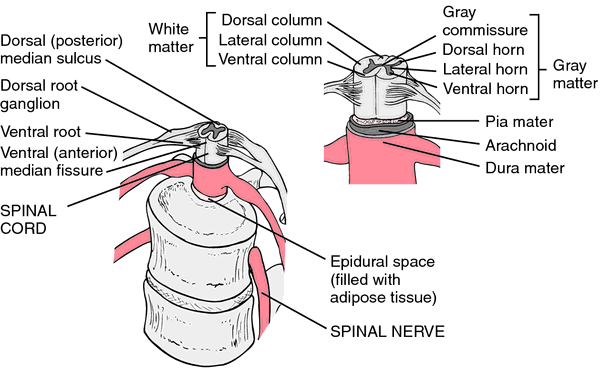
spinal cord that part of the central nervous system lodged in the spinal canal, extending from the foramen magnum to the upper part of the lumbar region. It is composed of an inner core of gray substance in which nerve cells predominate and an outer layer of white substance in which myelinated nerve fibers predominate. Called also medulla spinalis. (See Plates and see accompanying figures.)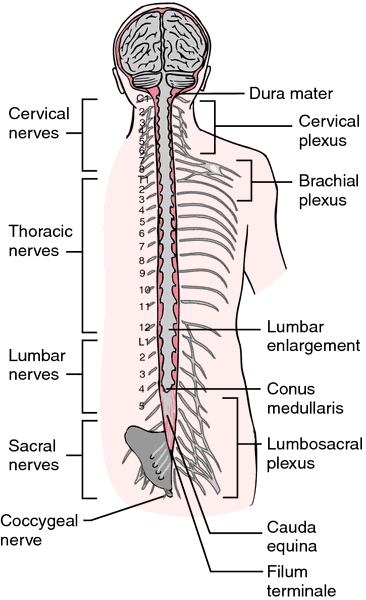
Gross anatomy of the spinal cord. From Applegate, 2000.
Cross section of the spinal cord. From Applegate, 2000.
Miller-Keane Encyclopedia and Dictionary of Medicine, Nursing, and Allied Health, Seventh Edition. © 2003 by Saunders, an imprint of Elsevier, Inc. All rights reserved.
spi·nal cord
[TA]the elongated cylindric portion of the cerebrospinal axis, or central nervous system, which is contained in the spinal or vertebral canal.
Farlex Partner Medical Dictionary © Farlex 2012
spinal cord
n.
The thick, whitish cord of nerve tissue that extends from the medulla oblongata down through the spinal column and from which the spinal nerves branch off to various parts of the body.
The American Heritage® Medical Dictionary Copyright © 2007, 2004 by Houghton Mifflin Company. Published by Houghton Mifflin Company. All rights reserved.
spi·nal cord
(spī'năl kōrd) [TA]The elongated cylindric portion of the cerebrospinal axis, or central nervous system, which is contained in the spinal or vertebral canal.
Synonym(s): medulla spinalis.
Synonym(s): medulla spinalis.
Medical Dictionary for the Health Professions and Nursing © Farlex 2012
spinal cord
The downward continuation of the BRAINSTEM that lies within a canal in the spine (VERTEBRAL COLUMN). The cord is a cylinder of nerve tissue about 45 cm long containing bundles of nerve fibre tracts running up and down, to and from the brain. These tracts form SYNAPSES with the 62 spinal nerves that emerge in pairs from either side of the cord, between adjacent vertebrae, and carry nerve impulses to and from all parts of the trunk and the limbs.Collins Dictionary of Medicine © Robert M. Youngson 2004, 2005
spinal cord
a cable-like nervous structure in vertebrates, enclosed in the backbone and extending the full length of the body behind the head. Pairs of spinal nerves leave the cord in each segment of the body The cord forms part of the CENTRAL NERVOUS SYSTEM and contains many NERVE CELLS and bundles of fibres, many associated with simple REFLEX ARCS, others with the brain. Coordination of movement of various parts of the body is brought about in the spinal cord.Collins Dictionary of Biology, 3rd ed. © W. G. Hale, V. A. Saunders, J. P. Margham 2005
Spinal cord
Elongated nerve bundles that lie in the vertebral canal and from which the spinal nerves emerge.
Mentioned in: Coccyx Injuries
Gale Encyclopedia of Medicine. Copyright 2008 The Gale Group, Inc. All rights reserved.
spi·nal cord
(spī'năl kōrd) [TA]The elongated cylindric portion of the cerebrospinal axis, or central nervous system, which is contained in the spinal or vertebral canal.
Synonym(s): medulla spinalis.
Synonym(s): medulla spinalis.
Medical Dictionary for the Dental Professions © Farlex 2012