abruptio
[ab-rup´she-o] (L.)separation.
abruptio placen´tae premature separation of a normally situated but improperly implanted placenta; it usually occurs late in pregnancy, but may take place during labor. Separation of the placenta before the 24th week of pregnancy is considered a spontaneous abortion if the abruption is so severe that the pregnancy is lost.
Contributing factors include multiple pregnancies (grand multiparity), chronic hypertensive disease, direct trauma to the uterus, or sudden release of amniotic fluid.
Premature separation of the placenta is classified from Grade 0 to Grade 3 according to the degree of separation. In Grade 0 mother and fetus are asymptomatic. Diagnosis is made after delivery when the placenta is examined and a clot is found adhering to the maternal surface. Grade 1 is minimal separation that causes some vaginal bleeding and changes in maternal vital signs. Fetal distress and hemorrhagic shock are absent. Grade 2 is moderate separation in which there is evidence of fetal distress and maternal symptoms of a tense uterus and pain on palpation. Grade 3 is the most serious. There is extreme separation which, without prompt intervention, can lead to maternal shock and fetal death.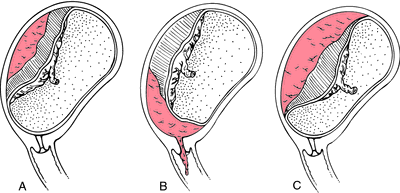
Contributing factors include multiple pregnancies (grand multiparity), chronic hypertensive disease, direct trauma to the uterus, or sudden release of amniotic fluid.
Premature separation of the placenta is classified from Grade 0 to Grade 3 according to the degree of separation. In Grade 0 mother and fetus are asymptomatic. Diagnosis is made after delivery when the placenta is examined and a clot is found adhering to the maternal surface. Grade 1 is minimal separation that causes some vaginal bleeding and changes in maternal vital signs. Fetal distress and hemorrhagic shock are absent. Grade 2 is moderate separation in which there is evidence of fetal distress and maternal symptoms of a tense uterus and pain on palpation. Grade 3 is the most serious. There is extreme separation which, without prompt intervention, can lead to maternal shock and fetal death.

Abruptio placentae. A, Mild abruption with concealed hemorrhage. B, Severe abruption with external hemorrhage. C, Complete separation with concealed hemorrhage.
Patient Care. Treatment and patient care are based on the grade of separation and maternal and fetal status. Maternal vital signs are monitored and blood loss is assessed. The uterus is assessed for any tenderness, tension, or rigidity. The location and nature of pain reported by the mother are noted; for example, a sharp stabbing pain high in the fundus can occur when separation begins. Pain that is in addition to the pain of contractions is also significant.
Oxygen may be administered to the mother to limit fetal anoxia. Fetal heart sounds are monitored for signs of fetal distress. The patient is kept in a lateral rather than supine position during labor to prevent pressure on the vena cava and further inhibition of fetal blood supply. Vaginal or pelvic examinations and an enema are restricted lest the placenta be disturbed further.
Grade 2 and Grade 3 separations require delivery as soon as possible, either vaginally or by cesarean section. Without prompt and effective intervention, abruptio placentae can lead to maternal death from hemorrhage, shock, and circulatory collapse. Fetal prognosis depends on the extent of hypoxia suffered by the fetus during labor and delivery.
Oxygen may be administered to the mother to limit fetal anoxia. Fetal heart sounds are monitored for signs of fetal distress. The patient is kept in a lateral rather than supine position during labor to prevent pressure on the vena cava and further inhibition of fetal blood supply. Vaginal or pelvic examinations and an enema are restricted lest the placenta be disturbed further.
Grade 2 and Grade 3 separations require delivery as soon as possible, either vaginally or by cesarean section. Without prompt and effective intervention, abruptio placentae can lead to maternal death from hemorrhage, shock, and circulatory collapse. Fetal prognosis depends on the extent of hypoxia suffered by the fetus during labor and delivery.
Miller-Keane Encyclopedia and Dictionary of Medicine, Nursing, and Allied Health, Seventh Edition. © 2003 by Saunders, an imprint of Elsevier, Inc. All rights reserved.
abruptio placentae
The premature separation of the placenta from its site of implantation in the endometrium before the delivery of the foetus, commonly known as placental abruption. Some degree of AP occurs in 1:85 deliveries; severe AP with total separation of the placenta is an obstetric emergency seen in 1 in 500–750 deliveries, often accompanied by foetal death.Clinical findings
Abdominal and/or back pain; irritable, tender or hypertonic uterus; vaginal bleeding (seen in most); 30% are asymptomatic.
Predisposing factors
Pre-eclampsia, eclampsia, chronic hypertension, diabetes, chronic renal disease; mechanical causes are rare (1–5%) and include transabdominal trauma, sudden decompression (as occurs in the delivery of a 1st twin or rupture of membranes in hydramnios) or traction of a short placenta.
Pathophysiology, proposed mechanisms
Local vascular injury of the decidua basalis with bleeding and haematoma formation, which causes shearing of adjacent denuded vessels, exacerbating the bleeding and haematoma; abrupt increased in uterine venous pressure transmitted to intervillous space, resulting in venous bed engorgement and separation of part or the entire placenta.
Management
Expectant therapy if foetus is immature and bleeding limited, treat shock if present; vaginal delivery if possible, or else C-section.
Complications
DIC, acute cor pulmonale, renal cortical and tubular necrosis, uterine apoplexy, transfusion hepatitis.
Definable, direct causes that trigger placenta abruptio
Rare (1 to 5%) mechanical factors such as abdominal trauma (for example, from an automobile accident or fall), sudden loss in uterine volume as occurs with rapid loss of amniotic fluid or the delivery of a first twin, or an abnormally short umbilical cord (usually only a problem at the time of delivery). Predisposing factors include the following risk factors: a past medical history of placenta abruptio (after 1 prior episode there is a 10 to 17% recurrence; after 2 prior episodes the incidence of recurrence exceeds 20%); hypertension during pregnancy is associated with up to 18% incidence (however, approximately 50% of placenta abruptio cases severe enough to cause foetal death are associated with hypertension); increased maternal age; increased number of prior deliveries; increased uterine distention (as may occur with multiple pregnancies or abnormally large volume of amniotic fluid); diabetes mellitus in the pregnant woman; cigarette smoking; and drinking alcohol during pregnancy (> 14 drinks per week). The incidence of placenta abruptio, including any amount of placental separation prior to delivery, is about 1 out of 77–89 deliveries; however, the severe form (resulting in foetal death) occurs only in about 1 out of 500–750 deliveries.
Segen's Medical Dictionary. © 2012 Farlex, Inc. All rights reserved.
ab·rup·ti·o
(ă-brŭpshē-ō)Nonphysiologic separation of tissues that should normally adhere.
Medical Dictionary for the Health Professions and Nursing © Farlex 2012
abruptio
Separation. From Latin abruptus , broken off.Collins Dictionary of Medicine © Robert M. Youngson 2004, 2005